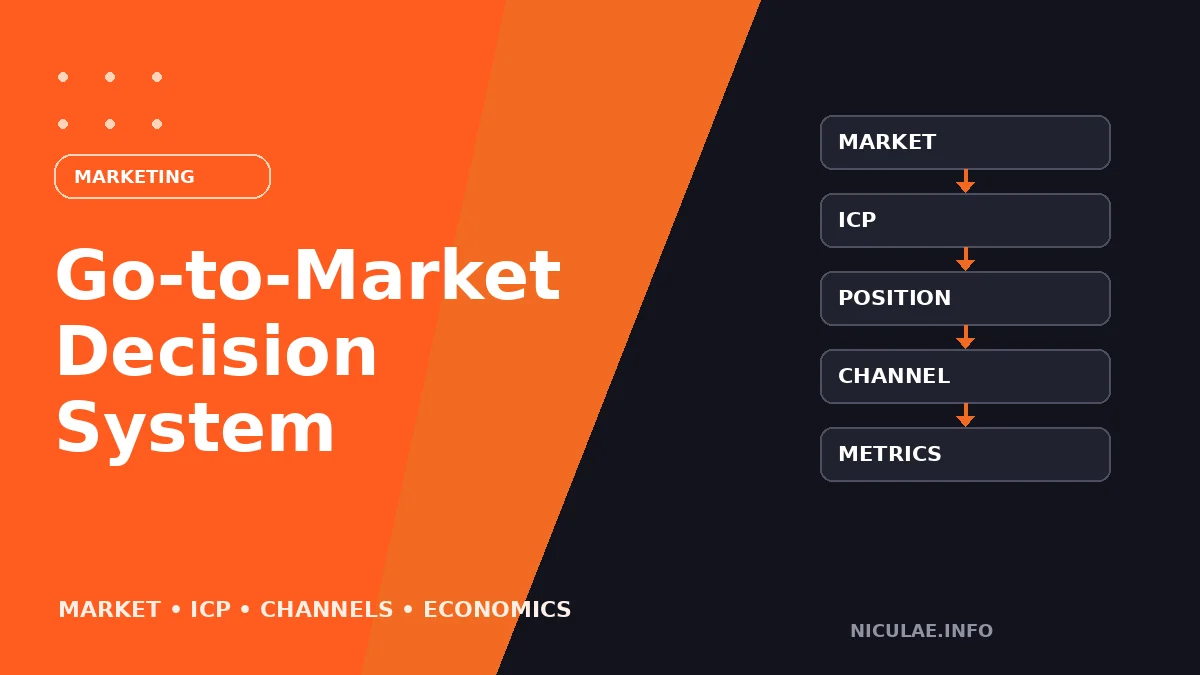
Short answer: a go-to-market strategy is the set of decisions that connects a specific offer to a specific market through a clear value proposition, distribution model, commercial system and measurement plan. It is not just a launch calendar. A strong GTM answers six questions: Which market? Which ICP? Which problem/value? Which positioning? Which distribution path? Which economics and success metrics?
GTM strategy vs marketing strategy
These terms overlap, but they solve different operating problems.
A marketing strategy is broader and ongoing. It allocates resources across markets, positioning, brand, channels, demand creation and measurement.
A go-to-market strategy is more specific. It is the plan for taking a particular offer into a market or segment and creating repeatable adoption.
You need GTM when:
- launching a new product;
- entering a new market;
- targeting a new segment;
- changing pricing or packaging materially;
- introducing a new sales/distribution motion.
The six executive decisions
1. Which market?
Do not start with channels.
Define the market boundary:
- geography;
- category;
- customer type;
- use case;
- regulatory/technical constraints;
- competitive alternatives.
The purpose is not to make a huge TAM slide. It is to define the arena where the offer has a realistic chance of winning.
Evidence can include:
- existing customer patterns;
- market research;
- demand signals;
- competitor coverage;
- channel access;
- regulatory/operational feasibility.
2. Which ICP?
An ICP should guide resource allocation.
It needs enough specificity to answer:
- who has the problem;
- how painful/frequent it is;
- who owns the budget;
- who influences the decision;
- what triggers action;
- what makes the prospect a poor fit.
If every possible buyer qualifies, the ICP is not doing strategic work.
3. Which problem and value?
Separate the product feature from the business job.
A useful structure is:
Situation → Problem → Consequence → Desired outcome → Evidence
For example, “AI-enabled marketing automation” is a capability. The actual value might be reducing response time, removing manual routing, increasing activation or improving decision quality.
The value proposition must survive contact with finance and operations, not only marketing copy.
4. Which positioning?
Positioning determines the mental comparison.
The customer needs to understand:
- what category this is;
- for whom it is designed;
- what problem it solves;
- what alternative it replaces;
- what evidence supports the difference.
Weak positioning tries to win every comparison at once.
Strong positioning chooses the frame where the offer is most defensible.
5. Which distribution path?
Distribution can include:
- product-led/self-service;
- direct sales;
- channel/partners;
- marketplaces;
- inbound demand;
- outbound;
- paid acquisition;
- community;
- events;
- hybrids.
The right distribution model depends on:
- deal size;
- sales complexity;
- buying committee;
- implementation burden;
- payback period;
- trust requirements;
- market reach.
Do not copy a competitor's channel mix without matching its economics and capabilities.
6. Which economics and success metrics?
A GTM system should connect acquisition activity to unit economics.
Define:
- target CAC or acquisition efficiency;
- payback expectations;
- gross margin constraints;
- conversion assumptions;
- retention/expansion assumptions;
- sales cycle;
- capacity constraints.
Then define launch success at several levels:
Signal metrics
- qualified conversations;
- trial/activation;
- demo acceptance;
- channel engagement.
Commercial metrics
- pipeline;
- bookings/revenue;
- CAC;
- payback;
- retention.
Learning metrics
- objections;
- loss reasons;
- activation friction;
- message resonance;
- channel quality.
The GTM pre-mortem
Before launch, assume the GTM failed and ask why.
| Failure mode | Evidence needed before launch |
|---|---|
| wrong segment | interviews, historical conversion, demand signals |
| weak problem | urgency/frequency evidence |
| unclear positioning | message tests, win/loss insight |
| bad channel economics | CAC/payback model |
| sales not enabled | playbook, objections, qualification criteria |
| product not ready | activation/support evidence |
| measurement blind | event/CRM/attribution instrumentation |
A pre-mortem is valuable because it forces assumptions into testable statements.
A 90-day operating cadence
Days 1–30: evidence and design
- validate market and ICP;
- gather primary customer evidence;
- map buying process;
- define value/positioning hypotheses;
- model unit economics;
- instrument measurement.
Days 31–60: controlled launch
- launch to a narrow cohort;
- monitor objections and activation;
- test positioning/channel assumptions;
- fix operational friction;
- avoid scaling spend prematurely.
Days 61–90: scale the validated parts
- increase investment only where evidence supports it;
- formalize sales/partner enablement;
- refine lifecycle automation;
- establish weekly GTM review;
- document lessons and rejected assumptions.
GTM is a system, not a deck
Product Marketing Alliance frameworks commonly connect discovery, strategy, definition, enablement and ongoing growth. That is useful because GTM does not end on launch day.
The system must continue learning:
- who converts;
- who retains;
- which objections repeat;
- where the handoffs fail;
- where economics are stronger or weaker than planned.
Executive conclusion
A GTM strategy is a sequence of high-consequence choices.
Define the market, ICP, value, positioning, distribution and economics before scaling tactics. Then run the launch as an evidence-generating system.
If the choices are weak, more campaign execution accelerates waste. If the choices are strong, execution becomes easier to coordinate and measure.
FAQ
What is a go-to-market strategy?
A go-to-market strategy connects a specific offer to a specific market through a clear value proposition, distribution model, commercial system and measurement plan.
What decisions should a GTM strategy answer?
It should answer which market, which ICP, which problem and value, which positioning, which distribution path, and which economics and success metrics.
Is a GTM strategy the same as a launch calendar?
No. A launch calendar is an execution artifact; GTM strategy is the decision system that determines how the offer reaches and wins in the market.