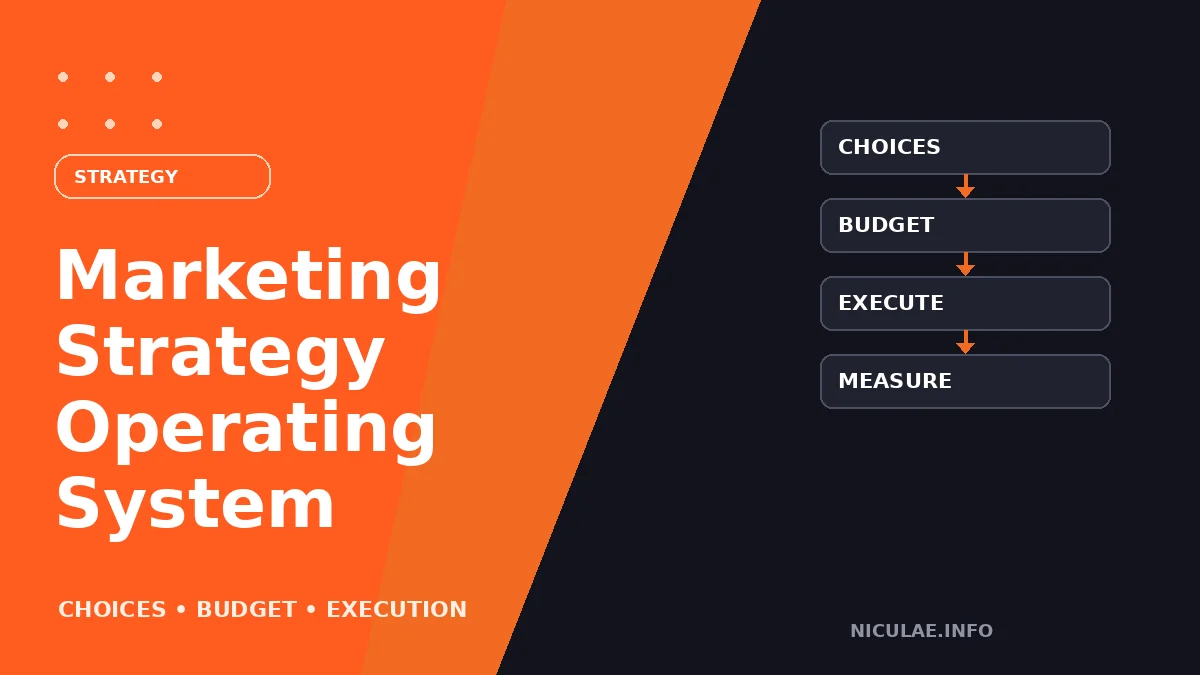
Short answer: marketing strategy is the coordinated set of choices that determines where the company will compete, how it will create demand and differentiation, which capabilities it needs, how resources are allocated and how success is measured. A strategy is not a channel list. It should connect Business Objective → Market Choice → Positioning → Growth Model → Channel Portfolio → Capabilities → Budget → Measurement.
Strategy is a choice system
Many marketing plans are collections of activities:
- SEO;
- paid social;
- email;
- events;
- content;
- influencers;
- automation.
That is a channel inventory, not necessarily a strategy.
Strategy begins when the organization makes choices under constraints.
Which customers matter most? Which category or problem do we want to own? What will we not spend on? Which capabilities create an advantage? What evidence would make us reallocate budget?
The American Marketing Association describes marketing strategy as a coordinated plan of action that guides marketing efforts, tactics and resources. The operative word is coordinated.
The strategy stack
1. Business objective
Marketing should start from the economic problem.
Examples:
- enter a new category;
- increase profitable acquisition;
- reduce churn;
- expand share in an existing segment;
- improve margin mix;
- build a brand before a market expansion.
Without the business objective, channel metrics become ends in themselves.
2. Market choice
Which market or segment deserves disproportionate investment?
Evaluate:
- size and growth;
- profitability;
- access;
- competitive intensity;
- fit with current capabilities;
- regulatory/operational constraints;
- strategic importance.
Choosing a market implies not choosing something else.
3. Positioning
Positioning defines how you want the market to understand the offer relative to alternatives.
It should be supported by:
- customer evidence;
- competitive context;
- credible differentiation;
- proof.
A positioning statement that could describe ten competitors is not doing enough strategic work.
4. Growth model
How does growth happen?
Possible mechanisms include:
- new customer acquisition;
- higher conversion;
- increased usage;
- repeat purchase;
- retention;
- cross-sell/upsell;
- partner distribution;
- geographic expansion;
- category expansion.
The growth model determines which metrics and capabilities matter most.
5. Channel portfolio
Channels should be treated as a portfolio, not individual silos.
Evaluate each by:
- reach;
- intent;
- cost;
- speed;
- incrementality;
- learning value;
- brand contribution;
- operational dependency.
A high-ROAS retargeting campaign can look efficient while contributing little incremental growth. A brand investment can look weak on last-click attribution while improving future demand.
The portfolio view prevents local optimization from becoming strategy.
6. Capabilities and MarTech
Strategy requires capabilities.
Examples:
- research;
- creative production;
- paid media expertise;
- CRM/lifecycle;
- analytics;
- experimentation;
- automation;
- content operations;
- product data;
- AI systems and governance.
Technology should support the operating model. It should not define it.
Buying more tools without ownership, data quality and workflow design creates complexity, not capability.
7. Budget and resource allocation
Budget is where strategy becomes real.
A useful allocation process distinguishes:
Core
Proven activities that sustain current performance.
Growth
Validated opportunities with room to scale.
Experiments
Controlled tests with explicit learning goals and spending limits.
Capability investment
Data, technology, research, creative or process improvements that increase future productivity.
Every allocation should have a reason and a review trigger.
8. Measurement and governance
Define metrics at multiple levels.
Business
- revenue;
- margin;
- customer lifetime value;
- retention;
- market share where observable.
Marketing outcome
- qualified demand;
- incremental conversions;
- CAC/payback;
- pipeline contribution;
- activation/adoption.
Operational
- creative throughput;
- experiment velocity;
- data quality;
- campaign cycle time;
- automation failure rate.
The governance question is:
What decision changes when this metric changes?
If no decision changes, the metric may be informational but not strategic.
Strategy vs plan vs campaign
| Layer | Core question | Typical horizon |
|---|---|---|
| strategy | Where and how will we win? | annual / multi-year |
| plan | What will we do with available resources? | quarterly / annual |
| campaign | How will we influence a specific audience/outcome? | weeks / months |
| tactic | What execution step supports the campaign? | days / weeks |
Confusing these levels creates tactical drift.
The operating cadence
Annual or strategic cycle
- revisit market/segment choices;
- update positioning evidence;
- review growth model;
- set major capability/budget choices.
Quarterly
- reallocate budget based on evidence;
- approve experiments;
- review pipeline/retention economics;
- update major risks.
Monthly/weekly
- monitor execution and exceptions;
- review experiments;
- resolve cross-functional blockers;
- avoid rewriting strategy because one campaign had a bad week.
What AI changes — and what it does not
AI can change the cost and speed of:
- research;
- analysis;
- content operations;
- software/automation;
- reporting;
- personalization.
It does not remove the need to choose markets, define positioning, allocate budget or decide which risks are acceptable.
In fact, cheaper execution can make strategy more important because the organization can now produce more activity faster. Without strong choices, AI accelerates noise.
Executive conclusion
Marketing strategy is an operating system for choices and resources.
Start with the business objective and market. Define positioning and the growth model. Build a channel portfolio around incrementality and learning, not vanity metrics. Invest in capabilities that make the model executable. Allocate budget explicitly. Then measure at the level where decisions actually change.
The result is not a prettier marketing plan. It is a more disciplined way to decide what marketing should do — and what it should stop doing.
FAQ
What is marketing strategy?
Marketing strategy is the coordinated set of choices that determines where the company will compete, how it will create demand and differentiation, which capabilities it needs, how resources are allocated and how success is measured.
Is a channel list a marketing strategy?
No. A strategy should connect business objectives, market choice, positioning, growth model, channel portfolio, capabilities, budget and measurement.
Why treat marketing strategy as an operating system?
Because strategy should continuously connect choices, budget, execution and measurement rather than exist as a static planning document.