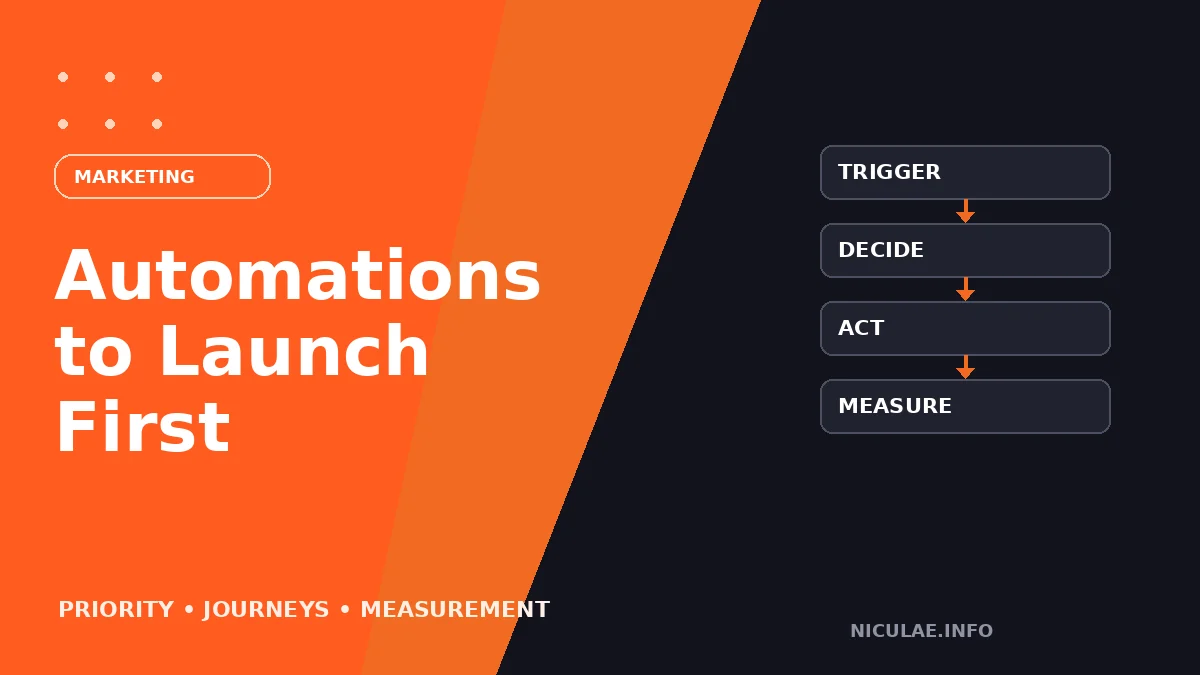
Short answer: start with automations tied to clear customer events, measurable outcomes and reliable data. The first wave should usually cover onboarding, lead nurture, abandonment/recovery, post-purchase value, renewal/expansion, reactivation and human handoff. Prioritize by revenue proximity × event frequency × data readiness ÷ operational risk rather than by how easy a workflow is to build.
Why automation priorities matter
Marketing teams often automate whatever is easiest first:
- a newsletter welcome email;
- a birthday message;
- a generic nurture sequence.
That can create activity without building an operating system.
A better question is:
Which repeated customer or business event is important enough, frequent enough and measurable enough to deserve automation now?
The answer depends on the business model, but the prioritization logic can be standardized.
The four-factor priority model
Score each candidate automation from 1 to 5 on four dimensions.
Revenue proximity
How directly does the workflow affect acquisition, conversion, retention or expansion?
Event frequency
How often does the triggering event happen?
An automation for an event that occurs daily may create more value than a sophisticated workflow that runs five times a year.
Data readiness
Can the trigger, identity and outcome be measured reliably?
Operational risk
What happens if the automation is wrong?
High-risk examples:
- messaging someone during an active complaint;
- sending renewal language with incorrect terms;
- triggering duplicate financial or account actions;
- contacting people without the required permission.
A simple score can be:
Priority = (Revenue proximity × Event frequency × Data readiness) ÷ Operational risk
The formula is not a universal truth. It forces the team to make assumptions explicit.
1. Welcome and onboarding
Trigger
- account created;
- form converted;
- first purchase;
- subscription activated.
Objective
Move the user to the first meaningful value event.
Good design
- acknowledge the event immediately;
- explain the next useful action;
- branch based on what the person already did;
- stop or change the journey after activation.
KPI
Activation rate, time-to-value, early retention.
Stop condition
User reaches activation milestone or becomes ineligible.
2. Lead nurture
Trigger
A known prospect demonstrates relevant intent but is not ready for a sales or purchase action.
Objective
Increase decision quality and readiness, not simply send more emails.
Good design
- branch by problem/segment where evidence exists;
- use behavior to change sequence state;
- suppress contacts already in active sales conversations;
- create a clear handoff rule.
KPI
Qualified progression, meeting creation, pipeline contribution, incremental conversion.
Stop condition
Qualified handoff, disqualification, opt-out or inactivity threshold.
3. Abandonment and recovery
Microsoft documents trigger-based customer journeys around events such as cart abandonment and other real-time customer actions.
Trigger
- abandoned cart;
- incomplete signup;
- quote started but not submitted;
- payment failed;
- critical setup step not completed.
Objective
Remove friction or remind the person of unfinished intent.
Good design
Do not assume every abandonment needs a discount.
First ask:
- Was there an error?
- Was information missing?
- Is the user still eligible?
- Did they complete the action through another channel?
KPI
Recovered conversion, incremental margin, completion rate.
Stop condition
Completion, ineligibility, duplicate conversion or suppression.
4. Post-purchase and value expansion
Trigger
Purchase, contract activation or milestone completion.
Objective
Increase product success and lifetime value.
Good design
- confirm transaction;
- help the customer get value;
- recommend the next relevant action only after context exists;
- separate service messaging from promotional messaging.
KPI
Adoption, repeat purchase, expansion, support reduction, retention.
Stop condition
Customer completes the desired milestone or enters a different lifecycle state.
5. Renewal and expansion
Trigger
Approaching renewal, usage threshold, contract milestone or expansion signal.
Objective
Prevent avoidable churn and make expansion relevant.
Good design
- use product/service usage where available;
- distinguish low-engagement risk from high-value expansion opportunity;
- escalate high-value accounts to humans when appropriate.
KPI
Renewal rate, retained margin, expansion revenue.
Stop condition
Renewed, churned, escalated or contract state changed.
6. Reactivation
Trigger
Meaningful inactivity over a defined period.
Objective
Test whether the relationship can be reactivated economically.
Good design
- define inactivity by customer context, not one universal number;
- cap the number of attempts;
- stop if the contact remains unresponsive;
- avoid artificial urgency.
KPI
Reactivation rate, incremental revenue, unsubscribe/complaint rate.
Stop condition
Reactivated, opted out or max attempt reached.
7. Sales or service handoff
Trigger
- high-intent action;
- account risk;
- complaint/escalation;
- product-qualified lead;
- exception requiring judgment.
Objective
Move from automated handling to human handling without losing context.
Good design
The handoff should include:
- what happened;
- who is involved;
- relevant history;
- why the system escalated;
- recommended next action;
- SLA/owner.
KPI
Response time, resolution/conversion, handoff acceptance, outcome quality.
Stop condition
Human owner accepts, resolves or returns the case to automation with a documented state.
The automation table
| Journey | Trigger | Primary KPI | Critical suppression |
|---|---|---|---|
| onboarding | signup/purchase | activation | already activated |
| nurture | intent signal | qualified progression | active sales conversation |
| abandonment | incomplete high-value action | recovered conversion | already completed |
| post-purchase | purchase | adoption/repeat value | refund/service issue |
| renewal | renewal window | retained revenue | contract already resolved |
| reactivation | inactivity | reactivated value | opt-out/max attempts |
| handoff | high intent/risk | response/outcome | assigned/closed case |
What not to automate first
Avoid starting with workflows that have:
- unclear ownership;
- unreliable identity;
- no measurable outcome;
- high consequence and no approval path;
- complex branching before the basic data is trustworthy;
- low volume and low economic value.
A complicated journey does not become strategic because it has more nodes.
Measurement
Every workflow should log:
- trigger received;
- eligibility result;
- journey entry;
- branch/action selected;
- delivery/action outcome;
- conversion or stop condition;
- experiment/control status where relevant.
Measure the business outcome, not only opens and clicks.
Executive conclusion
Automate the repeated events closest to customer value first.
Start with journeys where the trigger is reliable, the business outcome is measurable and the risk is manageable. Build the lifecycle foundation before adding novelty.
The best automation roadmap is not the one with the most workflows. It is the one where each workflow has a clear economic job, a measurable outcome and a safe stop condition.
FAQ
Which marketing automations should launch first?
Start with automations tied to clear customer events, measurable outcomes and reliable data: onboarding, lead nurture, abandonment or recovery, post-purchase value, renewal or expansion, reactivation and human handoff.
How should automation priorities be ranked?
Prioritize by revenue proximity, event frequency, data readiness and operational risk rather than by how easy a workflow is to build.
Why not automate everything at once?
A smaller first wave makes measurement, governance and failure handling easier while proving which journeys create real business value.