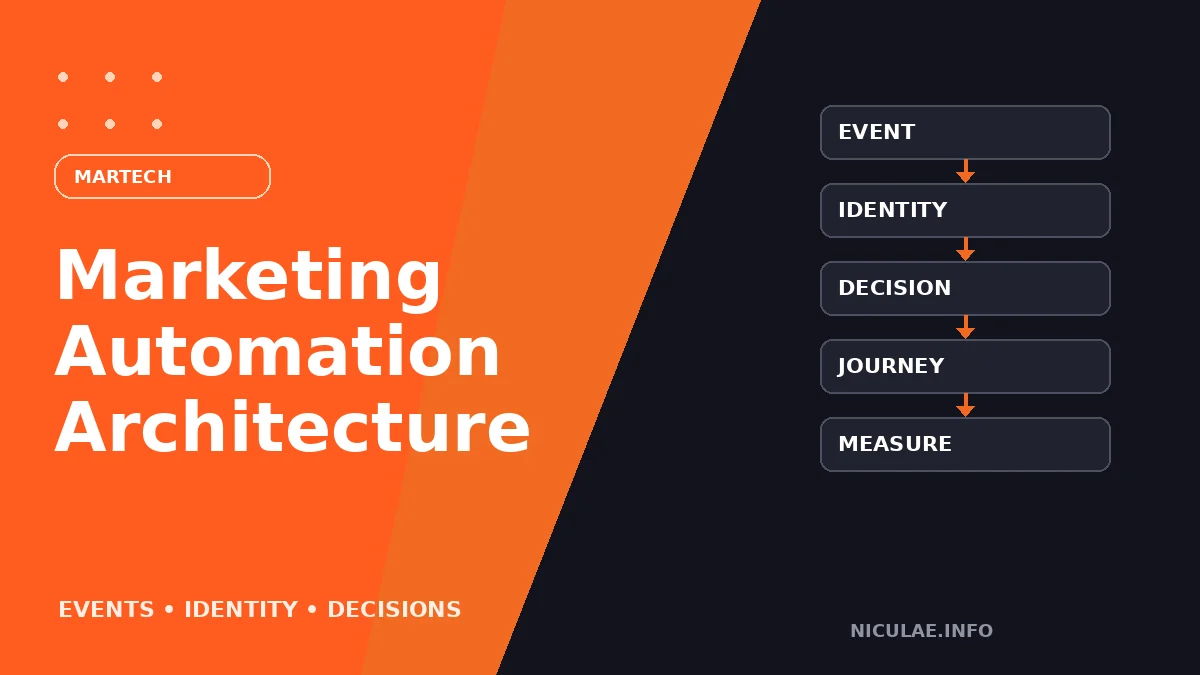
Short answer: marketing automation is not primarily a collection of email sequences. It is an operating architecture that turns customer or business events into controlled actions across channels. A reliable system connects Event → Identity → Decision → Journey → Channel → Measurement, with consent, suppression, observability and failure handling built in.
Why most automation diagrams start too late
Many marketing automation discussions begin with campaigns:
- welcome email;
- abandoned cart;
- nurture series;
- renewal reminder.
Those are outputs.
The real architecture begins earlier:
- What happened?
- Who did it?
- Are we allowed to act?
- What state is this person/account in?
- Which rule or model chooses the next step?
- Which channel should execute it?
- How do we know whether it worked?
If those layers are weak, adding more journeys multiplies inconsistency.
The six-layer reference architecture
1. Event
An event is the observable fact that starts or changes a workflow.
Examples:
- form submitted;
- product viewed;
- order completed;
- invoice overdue;
- contract renewal window opened;
- support case escalated;
- lead stage changed;
- inventory threshold crossed.
Microsoft documents trigger-based journeys around interaction events, business events and custom triggers. The exact platform is less important than the principle: automation needs a reliable event model.
A good event has:
- a stable name;
- a timestamp;
- an actor/entity identifier;
- relevant properties;
- an idempotency strategy where duplicate delivery is possible;
- a documented source system.
2. Identity
Before acting, the system must know who or what the event belongs to.
Identity may involve:
- person/contact ID;
- account/company ID;
- anonymous browser/session ID;
- order ID;
- device ID;
- email/phone;
- CRM record.
Identity resolution is not just data engineering. It directly affects customer experience.
If identity is wrong:
- people receive duplicate messages;
- existing customers receive acquisition offers;
- suppression rules fail;
- attribution becomes unreliable.
3. Decision
The decision layer determines what should happen next.
It can include:
- deterministic rules;
- segment membership;
- scoring thresholds;
- business policy;
- model output;
- frequency caps;
- consent state;
- inventory or eligibility checks.
A mature automation system does not ask only:
“Did the trigger fire?”
It asks:
“Given this event, this identity and current business/customer state, is this action still appropriate?”
4. Journey
A journey coordinates state over time.
It can contain:
- waits;
- branches;
- channel actions;
- stop conditions;
- re-entry rules;
- handoffs;
- conversion conditions.
Microsoft's journey model explicitly supports trigger-based and segment-based approaches. Salesforce describes marketing automation more broadly as technology for managing marketing processes and multi-channel campaigns automatically.
The architecture lesson is that journeys need state, not just scheduled sends.
5. Channel
Channels execute actions:
- email;
- SMS;
- push;
- ads/audience sync;
- CRM task;
- sales notification;
- webhook/API;
- website personalization;
- support workflow.
Each channel has different constraints:
- consent;
- cost;
- latency;
- deliverability;
- message limits;
- error semantics;
- rate limits.
The journey should not hide these operational differences.
6. Measurement
Automation should be observable as a system.
Track at least:
- event received;
- identity resolved;
- eligibility decision;
- journey entered;
- branch selected;
- message/action attempted;
- action delivered/failed;
- conversion or stop condition;
- revenue/value outcome where appropriate.
If you only track open and click rates, you are measuring the communication surface, not the automation system.
Governance is part of the architecture
Consent
Consent should be evaluated when the action is taken, not assumed from a stale segment export.
Suppression
Global and local suppression rules prevent harmful automation.
Examples:
- active support complaint;
- refund in progress;
- legal hold;
- unsubscribed contact;
- frequency cap reached;
- sales opportunity at a sensitive stage.
Quiet hours and regional policy
Time, jurisdiction and channel rules can differ. The system should not force every journey to implement them independently.
Deduplication
Events may arrive more than once. Actions should not accidentally double-charge, double-message or duplicate CRM tasks.
Human oversight
High-impact actions may require approval, especially when AI generates or selects content dynamically.
Failure handling
Every automation should define what happens when dependencies fail.
Questions to answer:
- What if identity resolution fails?
- What if the CRM is unavailable?
- What if an API returns 429?
- What if the same event arrives twice?
- What if the channel rejects the message?
- What if the person converts while waiting in the journey?
- What if consent changes during a wait step?
A workflow without failure semantics is a demo, not an operating system.
Measurement and attribution
Do not attribute every conversion touched by an automation to the automation.
Separate:
- delivery metrics;
- engagement metrics;
- conversion metrics;
- incremental effect.
For high-value journeys, use controlled experiments where feasible:
- holdouts;
- randomized delay;
- treatment vs control;
- geo or cohort comparisons.
Otherwise, a “successful” automation may simply be messaging people who were already likely to convert.
The reference architecture checklist
Event
- stable event contract;
- source documented;
- timestamp and ID;
- dedupe strategy.
Identity
- canonical IDs;
- merge rules;
- anonymous-to-known transition;
- account/person relationship.
Decision
- eligibility rules;
- consent;
- frequency caps;
- model/rule versioning.
Journey
- entry/re-entry rules;
- branches;
- waits;
- stop conditions;
- handoffs.
Channel
- provider limits;
- templates;
- localization;
- deliverability/error handling.
Measurement
- event-to-outcome trace;
- failure logging;
- experiment design;
- business KPI.
Executive conclusion
The quality of marketing automation is determined less by the number of workflows than by the quality of the operating architecture underneath them.
Start with events, identity and decision rules. Then orchestrate journeys. Treat channels as execution surfaces. Measure the full path, not just clicks. Put governance and failure handling in the design from the beginning.
Once that foundation is stable, adding the next automation becomes faster — and much less dangerous.
FAQ
What is marketing automation architecture?
It is an operating architecture that turns customer or business events into controlled actions across channels.
What are the core layers of a reliable automation system?
A reliable system connects Event, Identity, Decision, Journey, Channel and Measurement.
What governance belongs in marketing automation?
Consent, suppression, observability and failure handling should be built into the architecture rather than added later.
